Facilitating Business Simulations
A business simulation creates the experience. Facilitation is the bridge that joins that experience to shared reflection and into learning.
Without facilitation, participants still make decisions and experience consequences. Some learning will happen naturally. The role of the facilitator is to accelerate that learning. Not by providing the answers. But by helping participants make sense of what they've experienced.
Experience isn't enough.
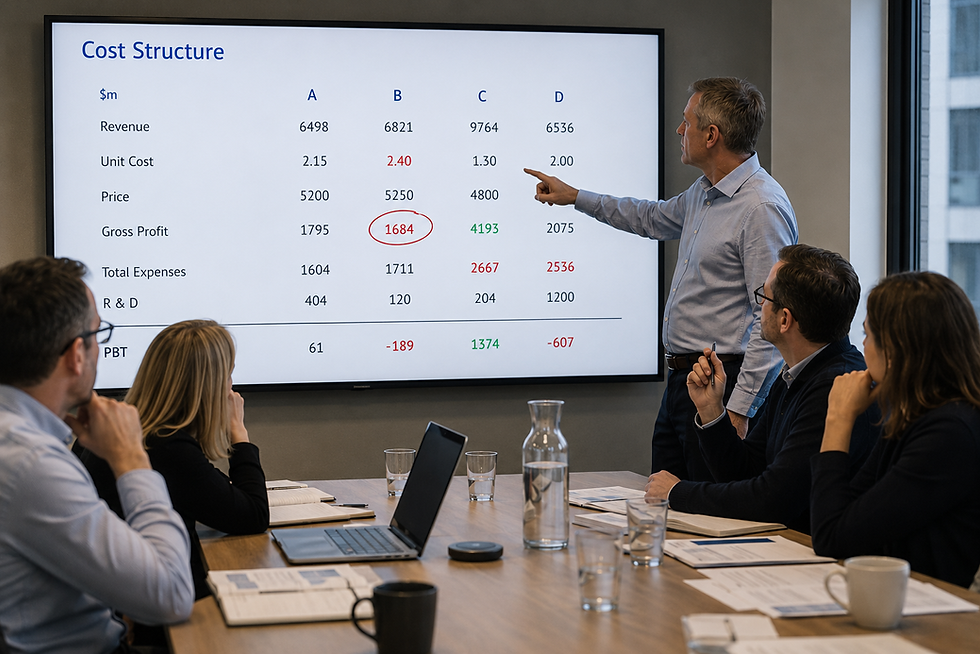
As a consequence of the decisions made during a round of the simulation, the team will receive their results. While eyes are naturally drawn to a team’s profit (or the lack of it!) a facilitated review will help the teams understand what’s happened and why.
Reviewing behaviours and processes
Our simulations are team based activities and so provide lots of opportunity to explore and review both individual and group behaviour. Below are three examples:
Task-specific
For example, in the first round of the simulation where we can expect teams to struggle with the volume of information, a review could look at how the team sifted data, where they spent their time and how this is similar or different to their real world.
Reviewing group processes
Here individuals might consider how their team has performed in terms of: Sense of purpose, Open communication, Trust, Participation Structure & Decision making. They can then compare views, discuss differences of opinion and agreed weaknesses.
Peer feedback
These are typically facilitated, with each person taking a turn in the ‘hot seat’ where they receive feedback and thank their team members for their observations.
The reviews usually happen after the round but before the teams have had their business results (so they’re not distracted by them) and can integrate with frameworks such as DISC and MBTI.
Reviewing business performance
While a programme might include theory input, in this context, the facilitator’s job isn't to explain the business. Rather, it is to help participants explain the business to themselves and each other.
We typically ask teams to look at their results briefly and then we’ll discuss together in plenary if the results are as the team expected, if not why not, and what they see as the key issues for the round ahead. When every commercial decision is a prediction, surprises matter.
How does commercial acumen develop →
The aim is therefore to help participants understand what happened and why. With larger groups we may need to run plenary reviews with a structure. With smaller groups, each team will typically have more space to explore and so they can be more fluid.
The simulation creates the experience. Good facilitation helps participants make sense of it.
And it is in making sense of what happened - and why - that much of the learning takes place.